


_3x.png)
ajaeng

South Korea, North Korea a large seven-stringed bowed zither, used in meditative melodies, accompany vocal or court music.
akkordolia

Germany, Austria a keyed zither with strings that are fretted by a row of buttons, similar to a typewriter, used as chordal accompaniment for folk-style performances in a home setting.
alpine zither

Austria, Germany, Switzerland a flat stringed instrument with a fretted neck for melodic strings and sympathetic drone strings, plucked with the fingers and a plectrum, use in traditional Central European folk music (Stubenmusik) and notable film scores.
appalachian dulcimer

United States (Appalachia) a fretted hourglass-shaped string instrument with three or four strings, laid flat and plucked or strummed with a "noter" (small stick), used in Appalachian folk songs, ballads, and to accompany singing.

autoharp
United States, Germany a fretted zither instrument with chord bars that mute specific strings when pressed, used for easy self-accompaniment in Appalachian folk, "old-time music", country, and bluegrass music
bulbul tarang

India, Pakistan a string instrument with a wooden body and a set of typewriter-like keys that are pressed to fret the strings while they are plucked or strummed, used in folk music, devotional songs (bhajans), and light classical music.
clavichord

Germany, Austria, Spain, Portugal, Italy, Sweden a rectangular keyboard instrument with metal tangents that strike and remain in contact with the strings to allow for expressive vibrato, used in private practice, composition, and intimate parlor performances of Baroque and Classical music.

clavicymbalum
Italy, France, Germany, United Kingdom, The Netherland a portable, wing-shaped keyboard instrument with a plucking mechanism, used in performing late Medieval and early Renaissance courtly music and liturgical melodies.
cymbalom

Hungary, Romania, Slovakia, Czech Republic, Moldova a large, hammered dulcimer with a trapezoidal shape and metal strings stretched across its top, used in orchestral compositions, folk ensembles, and traditional wedding music.
Đàn tranh

Vietnam a long, plucked zither with 16 to 25 stainless steel strings and movable bridges that allow for pitch bending and glissandos, used in traditional chamber music, royal court performances, and folk songs.
duxianqin

China a one-stringed zither with a flexible handle used to vary tension and a bamboo or wooden body, used in folk melodies and atmospheric solo performances.

gayageum
South Korea, North Korea a long plucked zither with twelve or more silk strings supported by individual movable bridges, used in court music and virtuosic folk styles like sanjo.
geomungo

South Korea, North Korea a long, six-stringed zither with movable bridges and fixed frets that are struck and plucked with a thin bamboo plectrum, used for scholarly meditation, court music, and expressive folk suites.
guqin

China a seven-stringed, bridgeless zither , used in solo art music, scholarly traditions, and contemplative performance.
gusli

Russia, Ukraine, Belarus a plucked psaltery-style instrument, used in traditional folk music, accompaniment for epic storytelling, and folk rituals.
guzheng

China, Taiwan, Singapore, Malaysia, Macau a large plucked zither with a long, arched soundboard and movable bridges, used in traditional folk music, operatic accompaniment, and modern orchestral compositions.
hackbrett

Switzerland, Austria, Germany, Slovenia a trapezoidal hammered dulcimer dozens of metal strings, used in Alpine folk music, dance accompaniment, and contemporary chamber music.
harpejji

United States a large, flat, rectagular stringed instrument played by tapping the strings on a fretboard with both hands, used in contemporary, modern jazz, film score, and solo pop performance.
harpsichord

Italy, France, Germany, Netherlands, United Kingdom, United States a piano-like keyboard instrument in which strings are plucked when keys are pressed, used in Baroque and early Classical music.
inanga

Burundi, Rwanda, Uganda, Democratic Republic of Congo a large, trough-shaped zither with a single continuous string wound through notches across a hollowed wooden board, used in storytelling and folk singing.
jakhe

Thailand, Laos a plucked zither with three strings and elevated frets, used in classical court ensembles and traditional chamber music.
kacapi

Indonesia (West Java) a plucked box zither with a wooden body, movable bridge, and metal strings, used in Tembang Sunda (aristocratic poetry) and Kacapi Suling (instrumental music).
kanklės

Lithuania a plucked box zither (or "psaltery") with a trapezoidal wooden body, decorative sound hole, and wire or gut strings, used in solo meditation, folk song accompaniment, and traditional Baltic ensemble music.

kannel
Estonia a plucked box zither (or "psaltery") with a trapezoidal wooden body and varying numbers of strings, used for accompaning ancient runosongs, traditional folk melodies, communal singing accompaniment, and meditative solo performances.
kantele

Finland, Karelia region (Finland/Russia) a plucked box zither with a trapezoidal wooden body and varying numbers of strings, used for ancient epic storytelling, traditional folk dances, and modern experimental music.
khim

Thailand, Laos, Cambodia, Myanmar a trapezoidal hammered dulcimer with metal strings, two rows of bridges played with bamboo beaters, used in classical ensembles, folk music, and meditative compositions.

kokles
Latvia a plucked box zither with a trapezoidal wooden body and a wing-like extension, used for solo meditative performances, singing accompaniment, and folk ensemble music.
koto

Japan a long, plucked zither with thirteen strings stretched over movable bridges, used in classical court music, traditional chamber ensembles, and contemporary solo compositions.

Lakadou
East Timor, Timor-Leste a tube zither made from bamboo with several "strings" carved directly from the bamboo's outer bark and elevated by small wooden bridges, used in traditional dances and folk songs.
langeleik

Norway a plucked drone zither with a long, box-shaped body, one melody string and several drone strings, used in folk dances and domestic music.

langspil
Iceland a drone zither with a long, narrow soundbox and one to six strings that are plucked or bowed, used to lead family singing during the kvöldvaka (evening wake), folk songs, communal storytelling, and hymns in rural communities.
marovany

Madagascar a box-shaped plucked zither with two sets of metal strings stretched over a hollow wooden resonator, used in ritual trance ceremonies (The "Tromba" Ceremony), spiritual healing, and traditional dance accompaniment.
Mvet

Equatorial Guinea, Gabon, Cameroon a stick-zither with three to five gourd resonators and strings made of vegetable fiber or metal, used by specialized poet-musicians for storytelling and oral history.
piano

Worldwide (Western Classical, Popular Music) a keyboard instrument that makes sound by striking metal strings with felt-covered hammers, use in Western classical composition, education, jazz, and a wide variety of popular music genres
psalmodicon

Sweden, Norway, Denmark a single-stringed, bowed or plucked fretboard zither with a wooden box body and printed letter or number notation, used to lead Congregational church singing, and in musical education in religious settings.
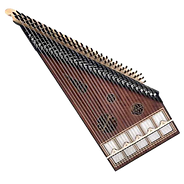
qānūn
Turkey, Lebanon, Syria, Iraq, Egypt, Armenia, Azerbaijan a flat, trapezoidal zither with a system of small metal levers and dozens of strings stretched over a wooden soundboard, used in classical and traditional Middle Eastern ensembles such as the Takht ensemble, Levant’s musical heritage, Maqam tradition, Rebetiko, and traditional folk music of Asia Minor .
santouri

Greece a trapezoidal hammered dulcimer with approximately 100 to 110 metal strings that are struck with two thin, cotton-tipped wooden sticks, used in folk dances and traditional island music.
santur

Iran, Iraq a trapezoidal hammered dulcimer with 72 or more metal strings stretched over small wooden bridges that are struck with lightweight wooden mallets, used inclassical art music and modal improvisations.
scheitholt

Germany, Austria a fretted zither (direct ancestor of the Appalachian dulcimer) with a slender wooden soundbox and several melodic and drone strings, use in domestic home entertainment, hymns, dance music, and rural gatherings.

shahi baaja
India, Pakistan a keyed electric box zither with a solid wooden body, a swarmandal (drone harp), 30 typewriter style keys, and electronic pickups, used for classical, folk, and contemporary fusion music, bhajans, bollywood film scores, psychedelic rock, indie, and ambient techno.
tsymbaly

Belarus, Ukraine, Poland a hammered dulcimer with a trapezoidal soundbox and strings stretched over a bridge, played by striking the strings with two small hammers, used in Eastern European folk ensembles and classical music.
ttun-ttun

Spain a large, wooden percussion instrument with six strings that run over a soundboard, which is typically played by striking the strings with a drumstick while they are tuned to a rhythmic drone, used in traditional dances and folk music.

ukelin
United States a string instrument with two sections: a fretted melodic section of 16 strings played with a bow and an unfretted harmonic section of 16 strings played by plucking, used in playing hymns and simple popular tunes.

valiha
Madagascar a tube zither with strings stretched lengthwise over a large bamboo tube resonator, played by plucking the strings with the fingers, used in traditional music and storytelling of Madagascar.

yangqin
China, Taiwan a trapezoidal hammered dulcimer played by striking its strings with small bamboo hammers, used in solo performance, Chinese orchestral music and opera.
yatga

Mongolia a long, rectangular, plucked zither with moveable bridges and 13 to 21 strings, used in Mongolian court music and folk songs.